
Home / Community safety
How to protect a business from break-ins in Detroit
A practical community safety guide for small businesses, landlords and homeowners in Detroit and Metro Detroit, with city-wide numbers from official data.
Detroit, city-wide: 2026 so far and 2025 (full year)
Source: City of Detroit Open Data Portal (Detroit Police Department “Police Serviced 911 Calls”). Data as of Oct 30, 2026 (fetched Oct 30, 2026). Saved copy; the page checks the City’s feed for newer calls. Not real time: the City publishes about a day behind. Calls are reports to police, not confirmed crimes. How these numbers are counted
Last updated
What the city-wide numbers tell a business owner
The counters above come from official City of Detroit data. In 2025, Detroit police serviced 1,192 911 calls coded as business break-ins, and 1,004 in 2026 so far (through Oct 30, 2026). The 2025 total works out to about 3.3 calls a day city-wide, and about 70% of them were made while the break-in was in progress. That means the moments right after someone tries a door or a window are when detection and response count most. Remember that a 911 call is a report, not a confirmed crime, and that the vandalism counter covers every kind of property, not just businesses. More detail is on our Detroit break-in and vandalism statistics page.
Step 1: Look at your property the way an intruder would
Walk around the building after dark. Which doors are out of sight from the street? Where are the shadows? Is there a ladder, dumpster or low roof that gives access to a window? Can you see the register, safe or stock from outside? Write down the three weakest spots; those are where the next steps should go first.
Step 2: Harden the back and side doors
Rear and side doors are often the target because they are hidden. Solid-core or metal doors, a latch guard over the gap by the lock, long screws in the hinges and strike plates, and a secure bar on the inside of doors that are not used for customers all make forced entry slower and noisier. Keep roof hatches and basement windows on the same list.
Step 3: Light it and keep it visible
- Light every entrance, including the back and the alley side, with dusk-to-dawn fixtures.
- Use motion lights over parking and receiving areas.
- Leave a light on inside so the sales floor can be seen from the street.
- Keep windows clear of posters that block the view in, and trim shrubs below window height.
Step 4: Close the same way every night
A consistent closing routine catches the unlocked door before anyone else does. Walk the same route nightly, empty the register and leave the drawer open, move high-value stock out of sight, set the alarm and confirm it armed. When you can, close with two people and agree who checks in with whom once you are both in your cars. Our how-to guides below break this into short checklists.
Step 5: Detect, verify and respond
Because so many business break-in calls are made while the break-in is happening, detection and response speed matter. An alarm with door, motion and glass-break sensors detects the attempt. Cameras with alerts show what is going on. Someone then has to respond. Many owners cannot drive to the building at 3 a.m. every time an alarm trips, and should not walk in alone. That is the gap alarm response and verification fills: an officer goes to the site and reports back whether the building is secure.
Step 6: Add people when the risk calls for it
For sites with repeated problems, valuable stock, or a temporary risk such as a broken window or a holiday shutdown, people make the difference. Mobile patrols make scheduled, varied checks after hours. Security guards provide a constant presence. After a break-in, emergency board-ups secure the opening the same night.
Vandalism: small fixes, done fast
Graffiti, broken glass and damaged fixtures are easier to deal with when they are fixed quickly; a property that looks cared for tends to stay that way. Photograph damage before repairing it for police and insurance, report it, then repair or clean it as soon as you can. Cameras covering walls and windows from a protected position, and lighting on blank walls, help too.
Work with your neighbors
Swap contact information with the businesses next door, share what you see, and agree to call if a neighbor’s alarm is going off or a door is open. Small business districts that look out for each other notice problems sooner. For emergencies, always call 911; never confront anyone yourself.
Want a professional to look at your property?
We can walk your business or home with you and suggest the mix of guards, patrols, alarm response or cameras that fits, with a quote built for your hours.
Simple habits that help
No special equipment needed for most of these. Nothing here can promise that a crime will not happen, but small, steady habits make a property a harder target.
Closing up a shop for the night
- Walk the same route every night: back door, side doors, windows, then the front.
- Leave a light on inside near the register area and keep the view from the street clear.
- Empty the register drawer and leave it open so it is easy to see there is nothing inside.
- Close with two people when you can, and agree who calls whom once you are both in your cars.
Lighting the outside of a home or building
- Light every door, including the back and side doors, not just the front.
- Motion lights over driveways and parking areas; dusk-to-dawn lights over entrances.
- Aim lights down and away from windows so neighbors and cameras are not blinded.
- Check bulbs and sensors once a month; replace a dead bulb the same week.
Doors, locks and windows
- Use the deadbolt every time, and replace short strike-plate screws with longer ones.
- Add a door security bar or a pin for sliding doors.
- Keep ladders and tools locked away so they cannot be used to reach windows.
- Rekey or change locks after moving in or when a key goes missing.
Packages, cars and the walk to your door
- Have packages held, delivered to a locker, or brought inside quickly.
- Keep nothing visible in a parked car, and lock it every time.
- Have your keys in hand before you reach the door or car; stay off the phone while you walk.
- Trust your instincts: if something feels off, go back inside or to a busy place.
Making a simple check-in plan
- Share your schedule with a family member, friend or co-worker when you work late or travel.
- Agree on a check-in text and what to do if it does not come.
- Save the non-emergency police number for your city in your phone; for emergencies, always call 911.
- Get to know your neighbors or the businesses next door and swap contact information.
DIY personal-safety tips
- Lock doors and windows, even when you are home or stepping out for a minute.
- Keep shrubs trimmed below window height so doors and windows stay visible.
- Post house numbers that can be read from the street at night, so help can find you.
- Write down serial numbers and take photos of valuables; it helps police and insurance.
- Do not post travel plans on social media until you are back home.
- If you see something suspicious, keep your distance and call 911; do not confront anyone.
Looking at cameras? See security camera installation & setup.
Want a professional to look at your property?
Savisa Security can walk your home or business with you and suggest guards, patrols, alarm response or cameras that fit.
DIY basics
- Test your smoke and carbon monoxide alarms monthly.
- Walk your property at night once a season to spot dark areas.
- Keep a small flashlight by the door and in the car.
Recent calls: a snapshot
The most recent calls the City has published (about a day behind, not real time). Location is the nearest intersection or block the City publishes; no business names, victim details or exact addresses.
Business break-in calls
Tied to business locations by the 911 call type (“burglary, business”).
- Business break-in (911 call) Oct 30, 2026 Greenfield Rd & W 7 Mile Rd
- Business break-in (911 call) Oct 28, 2026 Grand River Ave & Lahser Rd
- Business break-in (911 call) Oct 28, 2026 Burt Rd & Lyndon St
- Business break-in (911 call) Oct 28, 2026 Greenfield Rd & Elmira St
- Business break-in (911 call) Oct 28, 2026 Gladys St & Daniels St
- Business break-in (911 call) Oct 28, 2026 W McNichols Rd & Livernois Ave
Vandalism and theft calls, city-wide (any property type)
Detroit’s data does not say whether these involved a business or a home, so they are not counted as business incidents.
- Vandalism, any property type (911 call) Oct 30, 2026 Cloverlawn St & Joy Rd
- Vandalism, any property type (911 call) Oct 29, 2026 Saint Aubin St & E Larned St
- Larceny / theft, any property type (911 call) Oct 30, 2026 E Jefferson Ave & Bates St
- Larceny / theft, any property type (911 call) Oct 30, 2026 Gratiot Ave & Leland St
Source: City of Detroit Open Data Portal (Detroit Police Department “Police Serviced 911 Calls”). Data as of Oct 30, 2026 (fetched Oct 30, 2026). Saved copy; the page checks the City’s feed for newer calls. Not real time: the City publishes about a day behind.
Map: business break-in and vandalism calls, Oct 2025 to Sep 2026
Each dot is one police-serviced 911 call, placed at the location the City publishes with the record. It shows calls city-wide and does not compare areas.
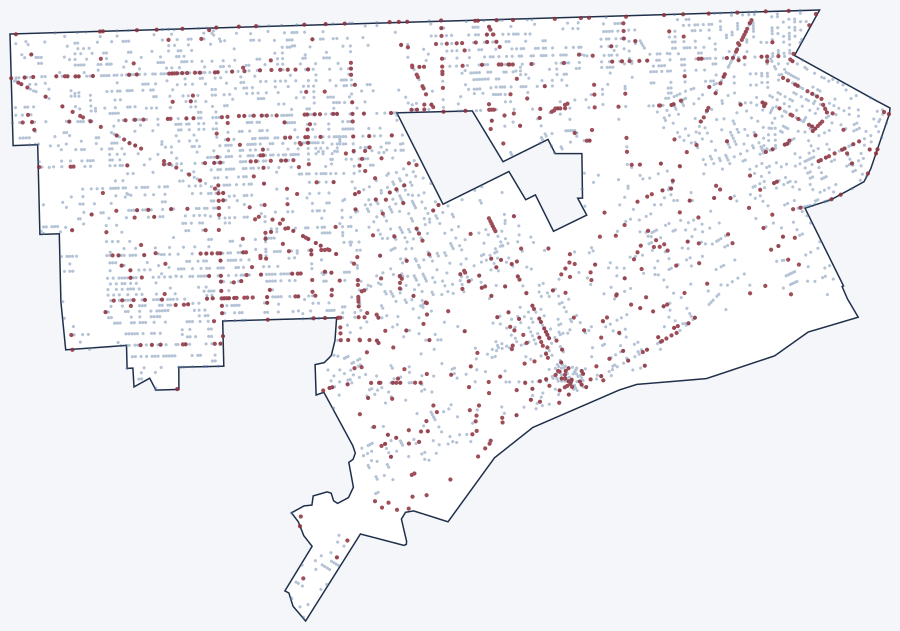
Map updated October 2026
- Business break-in calls (1,146)
- Vandalism calls, any property type (4,857)
Time window: Oct 1, 2025 to Sep 30, 2026 (the 12 most recent full months). Updated monthly.
Source: City of Detroit Open Data Portal (Detroit Police Department “Police Serviced 911 Calls”, published latitude and longitude). Data as of Sep 30, 2026 (fetched Oct 30, 2026). No business names or victim details. The map is a plain image on this site; no outside map service or tracking.
As an Amazon Associate I earn from qualifying purchases. The links in the box below are affiliate links to Amazon search results. If you buy through them, SavIsa Solutions may earn a commission at no extra cost to you. Amazon does not endorse SavIsa Solutions.
Frequently asked questions
What is the best way to prevent a business break-in?
Layer it: strong rear doors and locks, lighting, an alarm with fast verification, cameras, and a consistent closing routine. For higher-risk sites, add patrols or a guard.
What should I do after a break-in at my business?
Call 911 and do not go inside until police say it is clear. Photograph the damage, contact your insurer, secure the opening (a board-up if needed) and review what let the intruder in.
Does Detroit publish break-in data by business?
No. The City publishes 911 calls coded as business burglary city-wide, without business names. Vandalism data does not separate businesses from homes.
More answers on our FAQ page.
Need security in Detroit or Metro Detroit?
Licensed officers, supervisors available 24/7/365, and a quote built for your site.